
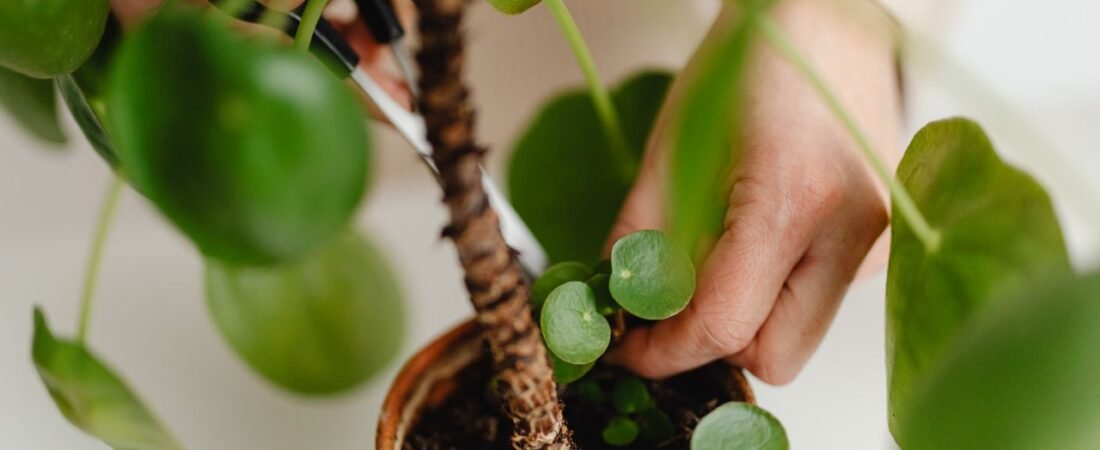
A monstera left alone grows into a glorious tangle — and then into a problem. Long vines flop over the edge of the pot, lower leaves yellow and drop, aerial roots wander across the floor, and the plant that once filled a corner nicely now blocks the doorway. Pruning is how you take back control. But a monstera is not a shrub: cut in the wrong place and you end up with a bare stem that never regrows.
The good news is that monstera pruning is simple once you know where the nodes are. This guide shows you when to prune, exactly where to cut, and what to do with the pieces you remove — including the honest truth that pruning alone will not make your plant bushier.
Prune your monstera in spring or early summer, cutting just above a node — about a quarter of an inch (roughly 1 cm) above it — with clean, sharp shears. Remove dead or yellow leaves at any time of year. Never take more than a third of the plant in one session, and never cut midway along a bare stretch of stem: only nodes can grow.
The 60-second triage: what to cut first
Before you pick up the shears, stand back and sort the plant into three piles: dead, damaged, and healthy. Cut the dead material first, then deal with shape. This table is the whole decision in one glance.
| What you see | Cut or keep | Where to cut |
|---|---|---|
| Completely yellow leaf | Cut — it will never turn green again | Leaf stalk at its base, a quarter inch from the stem |
| Brown, crispy leaf | Cut | Leaf stalk at its base |
| Leaf with a few brown spots but mostly green | Keep for now — fix the cause first | Trim only if the spots keep spreading; see our brown spots on monstera guide |
| Long bare vine with leaves only at the top | Top it, in spring | Main stem just above a node, at the height you want |
| Aerial root trailing across the floor | Guide it first; cut only if it is in the way | Close to the stem, without cutting into the node |
| Healthy green leaf you simply dislike | Keep — it is still feeding the plant | — |
When to prune a monstera
Timing matters more than technique. Prune while the plant is actively growing and the wound dries in two or three days, with the node below the cut often starting to grow within a month. Prune in the depths of winter and the cut sits open for weeks with nothing growing to compensate. North Carolina Extension advises pruning or repotting in spring, when the plant prefers temperatures of 60 to 85°F and bright, indirect light.
| Season | What to do |
|---|---|
| Spring | Best time for all pruning, including topping an overgrown plant |
| Early summer | Still good — growth is strong and wounds heal fast |
| Late summer and autumn | Light tidying only: dead leaves and the odd damaged stalk |
| Winter | Avoid heavy cuts; remove dead or rotten material only |
One case overrides the season entirely: remove a rotten leaf or soft stem immediately, whether it is December or May. Decaying tissue will not heal by waiting for spring, and it can spread. The same applies to leaves carrying pests or disease — take them off as soon as you spot them, and check the rest of the plant while you are at it.
Young plants deserve restraint. Wait until your monstera is two or three years old before doing any heavy pruning. Until then, stick to removing yellowing or damaged leaves and keeping the light, water, and feeding right — our monstera care guide covers the basics.
Find the node before you pick up the shears
Every correct monstera cut starts with finding a node. The node is the slight swelling on the main stem where a leaf stalk — the petiole — and sometimes an aerial root emerge. It holds the tissue that can make new growth. The internode, the smooth stretch of stem between two nodes, holds none: cut there and the bare section above the last living node dries out, blackens, and has to be cut back later anyway.
On an adult plant, nodes sit roughly 4 to 8 inches apart, and the spot where you wanted to cut rarely lines up with one on the first try. Look first, cut second. If the height you want falls between two nodes, cut above the lower one — the plant regrows from there, and you lose a little more length than planned but gain a living growth point.
Keep the two kinds of cut straight. Cutting a petiole removes one leaf and nothing else; the stem stays intact. Cutting the main stem removes everything above the cut and wakes the node below it. And a cutting only becomes a new plant if the piece you take includes a node — a bare leaf stalk will never root, however healthy it looks. That is the whole logic of propagation, covered step by step in our how to propagate monstera guide.
Tools you need — and how to clean them
You need very little, but the sharpness and cleanliness of the blade decide whether the cut heals or turns into an entry point for infection.
- Bypass pruning shears. An adult monstera stem is thick and fibrous — shears slice through it, while scissors crush the fibres and leave a ragged wound. For stems thicker than your thumb, loppers are the better tool.
- Rubbing alcohol (70%) or a disinfectant spray. Wipe the blades before the first cut, between visibly diseased sections, and again when you finish. A dirty blade carries bacteria from plant to plant.
- Gloves. Monstera sap contains needle-like calcium oxalate crystals that irritate skin, eyes, and mouths — in people, cats, and dogs alike. Wear gloves, keep your hands away from your face, and collect the trimmings rather than leaving them where a pet can reach them.
- A cloth and a bag. Wipe sap off the blades as you go, and bag the cuttings for disposal — never compost diseased material.
How to prune a monstera in 7 steps
Work through these steps in order. Most sessions only need steps 2 to 4; steps 5 and 6 are for plants that have genuinely outgrown their space.
- Decide your goal first. Stand back and look at the whole plant. Are you tidying dead leaves, shortening a vine that has reached the ceiling, or thinning crowded growth? The goal decides where every cut goes — never start cutting and work the goal out later.
- Sterilise your shears and put your gloves on. Wipe the blades with 70% alcohol and let them dry for a few seconds. Keep the alcohol and cloth beside you for the whole session.
- Remove dead material first. Take off every completely yellow, brown, or crispy leaf by cutting its stalk at the base, about a quarter of an inch from the main stem. Do not pull the stalk off — pulling tears a strip from the stem. Cut it short and leave the stub to dry; it drops off by itself.
- Thin crowded growth. Remove leaves that block light and air from the centre of the plant, and any small new leaves at the base that yellow before they ever develop splits. Cut each stalk at its base, the same way as step 3.
- Shorten long vines. Cut the main stem just above a node at the height you want, at a 45-degree angle, about a quarter of an inch above the node. The angle helps water run off so the wound dries fast. Never remove more than a third of the plant in one session — if it needs more, do the rest in a second session a few weeks later.
- Deal with aerial roots. Guide them toward the moss pole or push low ones into the potting mix first (see the section below). Cut only the one or two that trail across the floor and are genuinely in the way, cutting close to the stem without cutting into the node.
- Clean up and check back in a week. Wipe the shears, bag the trimmings, and wash your hands. Look at the cuts after a few days: they should be dry, not black or soft. If a cut blackens, trim it back to healthy tissue with a clean blade.
Removing a single leaf the right way
A single leaf is the most common cut, and the easiest to get wrong. Cut the petiole at its base, about a quarter of an inch from the stem, and leave the short stub to dry out — it falls away on its own. Never tear a leaf off by hand: the stalk rips a strip of tissue from the main stem and leaves a wound far bigger than a clean cut.
Be honest about which leaves actually need to go. A leaf that is still green, even with holes or few splits, is productive and worth keeping. If your monstera keeps producing small leaves without fenestrations, the problem is light or support, not a lack of pruning — see our guide to why monstera leaves are not splitting. And a leaf with a few brown patches can often stay until new growth replaces it; the cause — water stress, strong sun, or pests — needs fixing separately, not with the shears.
Topping an overgrown monstera
When a monstera reaches the ceiling, topping is the only real answer. Cut the main stem just above a node at the height that suits you. What happens next is predictable: the part left in the pot regrows from the node nearest the cut, often with two shoots instead of one, filling the plant out lower down. Expect four to eight weeks before you see new growth — that is normal, not a sign the cut failed.
Leave at least two or three leaf-bearing nodes on the base. A bare stump regrows, but slowly, and a plant with almost no leaves has little energy to grow with. The top you removed is not waste: if it carries one or more nodes, it roots readily in water or potting mix — follow our propagation guide and you get a second plant for free. If you want a fuller pot rather than a second pot, plant the rooted cutting back in with the parent: two stems in one pot gives a volume that pruning alone never will.
What to do with aerial roots
Aerial roots are the brown cords that emerge from nodes and dangle in the air. In the wild they anchor the plant to tree trunks and absorb water. They look untidy indoors, but do not cut them off automatically — they are doing a job.
| Option | When to use it | How |
|---|---|---|
| Guide them to the support | Best choice, whenever possible | Lay the root against the moss pole or coir support; it attaches within a few weeks and feeds the plant directly |
| Push them into the potting mix | Roots hanging low enough to reach the soil | Tuck the tip into the mix; it becomes an ordinary feeding root |
| Cut one or two | Only roots trailing on the floor and genuinely in the way | Cut close to the stem, without cutting into the node |
What you cannot do is strip them all away. The plant loses its anchorage and climbing ability, then compensates by growing new aerial roots in the same places — you end up with more roots, not fewer. If your plant is climbing well, a moss pole gives those roots somewhere useful to go.
Pruning roots at repotting time
Root pruning only belongs at repotting time, never as a shortcut to avoid a bigger pot. Lift the plant out and look at the root ball: a healthy root is firm and pale, from white to beige — untangle it by hand and leave it alone. A root that is brown and feels soft or hollow when pressed is dead: cut it with clean shears until you reach firm tissue. A root spiralling tightly around the ball can be scored vertically to encourage outward growth.
The limit is no more than a quarter of the root system removed at once. Beyond that, the remaining foliage is no longer adequately supplied and the plant drops leaves for weeks. And never combine severe leaf pruning with root pruning in the same session unless you have a compelling reason — the plant needs its leaves to recover from root work, and its roots to recover from leaf work. If you are unsure whether the plant needs a bigger pot at all, our signs your plant needs repotting guide and how to repot a monstera walk through the decision.
What pruning will not do
Honest expectations save more plants than sharp shears. Pruning will not turn a bare-stemmed monstera into a bushy one: long bare stems with a few leaves at the top come from low light or a missing support, and cutting above the bare section does not make leaves grow beneath it. Move the plant into brighter indirect light and give it a support first.
Nor does pruning speed growth. A pruned monstera starts again with less leaf area than before and needs a few weeks to regain its rhythm. It will not force larger leaves either — leaf size depends far more on the age of the plant, light, and support than on cutting foliage back. The only reliable increase in fullness comes from topping, which wakes lower nodes, and planting the resulting cutting in the same pot as the parent.
5 pruning mistakes to avoid
- Cutting mid-internode. The smooth stem between nodes cannot grow. The stub above the last living node dries, blackens, and has to be cut back later. Always find the node first.
- Taking more than a third at once. Removing a large share of the foliage in one session shocks the plant and triggers leaf drop. Heavy work belongs in two or three light sessions across the growing season.
- Pruning a weak or sick plant heavily. A drooping or yellowing plant is telling you something is wrong — fix the cause before you cut. Diagnose first — start with our overwatered vs underwatered guide, then our guides to why monstera droops and why monstera leaves turn yellow — and save the shears for a healthy plant.
- Using blunt or dirty tools. Blunt blades crush thick stems instead of slicing them, and dirty blades spread infection between plants. Sharp, clean, every time.
- Heavy pruning in winter. Healing is slow, the cut stays open longer, and there is no new growth to compensate for the foliage you removed. Winter is for dead leaves only.
Aftercare: what to expect in the next 8 weeks
A pruned monstera needs less fussing, not more. Water by the soil, not by a new rigid schedule — with fewer leaves the plant uses water more slowly, so check the top of the mix before watering (see our how often to water monstera guide). Do not reach for fertiliser to force fresh foliage; it does not work and can burn the roots. Put the plant back in its usual bright spot and leave it alone.
| When | What to expect |
|---|---|
| Days 1–3 | Cuts dry and sap stops beading; keep the plant out of direct sun for a day or two |
| Weeks 1–2 | Little visible change — normal. Water a little less than usual |
| Weeks 3–4 | The node below a stem cut may start to swell or push a shoot |
| Weeks 4–8 | New shoot unfurls after topping; a cutting in water usually shows roots in 2–3 weeks |
Watch for trouble in the first two weeks. A cut that blackens or turns soft should be trimmed back to healthy tissue with a clean blade. Drooping after a heavy session usually means the plant lost too much foliage at once — keep it in stable bright light, water normally, and give it time; our drooping guide helps you rule out other causes. If nothing has grown eight weeks after a spring cut, check the light and support — the plant is probably asking for brighter indirect light or a moss pole, not more pruning.
When to leave the shears alone
Some situations call for patience rather than pruning. Leave the shears in the drawer when the plant is weak or sick — drooping all over, yellowing everywhere, or soft stems mean something is wrong with water, light, or roots, and cutting will only weaken it further. Leave them alone just after repotting, while the plant is settling into its new pot, and through midwinter, when nothing you cut will regrow quickly. And if what you really want is a bushier plant, pruning alone will not deliver it — top the plant in spring and pot the cutting alongside the parent instead.
Most of the time, though, the answer is simpler than people expect. A monstera that gets bright indirect light, a moss pole to climb, and a light tidy in spring rarely needs anything more dramatic — see our best soil mix for monstera and humidity guide for the rest of the routine. Prune with a purpose, cut above a node, and let the plant do the rest.
Frequently asked questions
When is the best time to prune a monstera?
Spring to early summer, when the plant is actively growing — wounds dry in two or three days and the node below the cut often starts growing within a month. Remove dead or rotten leaves immediately at any time of year, but save heavy pruning for the growing season and avoid it in midwinter.
Where exactly do I cut a monstera?
Just above a node — the swelling on the stem where a leaf stalk or aerial root emerges — about a quarter of an inch above it, at a 45-degree angle. Never cut midway along a bare stretch of stem: the internode cannot grow, so the stub above the last living node dries out and blackens.
Will my monstera grow back after I cut it?
Yes. The stem left in the pot regrows from the node nearest the cut, often with two shoots instead of one, usually within four to eight weeks in the growing season. A removed leaf never regrows in the same spot — new leaves only emerge from growth points on the stem.
Should I cut off my monstera’s aerial roots?
Not as a routine. Aerial roots anchor the plant and absorb water, so guide them toward the moss pole or push them into the potting mix first. Cut only one or two that trail across the floor and are genuinely in the way, cutting close to the stem without cutting into the node.
Does pruning make a monstera bushier?
Not the way it works on a shrub. A monstera grows along a single stem and does not branch in response to pruning — it regrows from one or two buds below the cut. The only reliable way to add fullness is to top the plant and pot the cutting in the same container, so two stems grow side by side.