
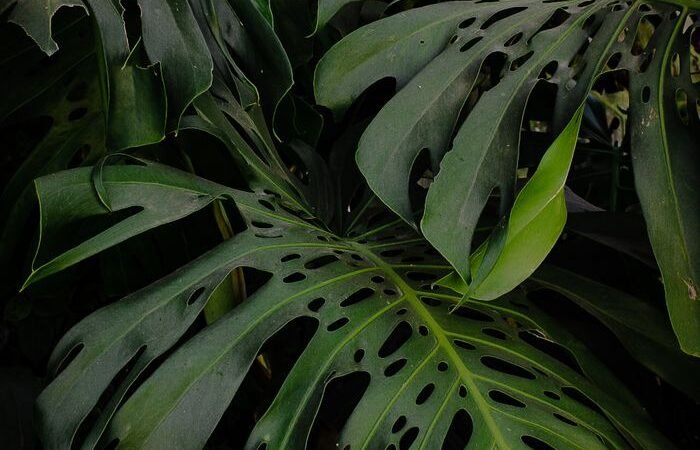
Your monstera is doing everything right — glossy green leaves, steady new growth — except the one thing you actually bought it for. No splits, no holes, no Swiss cheese. It’s the most common monstera frustration there is, and in almost every case it comes down to one of six bottlenecks. Run the quick diagnosis below, find your bottleneck, and fix that first.
Quick diagnosis
Most likely cause: not enough light reaching the leaves — or a plant that simply isn’t mature enough yet.
60-second check: Look at your newest leaf. If it’s small (under 8 inches), heart-shaped, and has no notches at all, your plant is still juvenile — give it brighter light and time. If older leaves have slits but the new ones don’t, your light dropped (a move, a season change, a new curtain) — move the plant closer to a bright window.
The rule that saves you guessing: fenestration shows up on new leaves only. Leaves that already opened solid will never split later, so judge every fix on the next 2–3 leaves, not the ones you have.
The fenestration ladder: what real progress looks like
Splits don’t arrive overnight as perfect holes. A maturing monstera climbs a ladder, one leaf at a time: solid heart-shaped leaves first, then small notches on the leaf edges, then deeper side slits, and finally the inner oval holes that make the classic Swiss-cheese look. Each new leaf can be one rung higher than the last.
That ladder is also how you set expectations. The first fenestrations typically appear once leaves reach roughly 10 to 13 inches wide — not on a calendar date. And one hard truth up front: a leaf unfurls either with splits or without them. It won’t develop new holes as it ages, so all your effort goes into the next leaf, not the ones already open.
Cause 1: Your monstera is still too young
Fenestration is a maturity trait, not a mood. A young Monstera deliciosa naturally produces small, solid, heart-shaped leaves for its first couple of years, and no amount of perfect care fast-forwards the biology. Most plants need 2 to 3 years before the first splits appear. North Carolina State Extension describes the species’ perforated leaves as a feature of mature plants — the plant has to earn them.
How to confirm: your plant is under about 2 years old (or a recent cutting), newest leaves are under 8 inches, and the stems haven’t started climbing.
- Don’t try to force it — there’s nothing to fix yet.
- Give it the conditions below anyway (light, pole, good soil), because a well-grown juvenile matures noticeably faster than a neglected one.
- Track leaf size, not the calendar: when new leaves pass ~10 inches, you’re close.
Cause 2: It’s not getting enough light
This is the number-one fixable cause. Growing big, split leaves takes a huge amount of energy, and in dim light the plant conserves energy by keeping leaves small and solid. Here’s the trap: monsteras survive in dim corners for years, which makes people assume the light is fine. Surviving is not the same as thriving — a plant ten feet from a window can stay green forever and never split a single leaf.
How to confirm: new leaves are smaller than older ones, stems look leggy with long gaps between leaves, or the whole plant leans hard toward the window.
- Move it to bright, indirect light: right by an east-facing window, or 3–5 feet back from a south-facing window behind a sheer curtain.
- No good window? A full-spectrum grow light 10–12 hours a day, a foot or two above the leaves, works just as well.
- Skip harsh direct afternoon sun — it scorches leaves instead of helping.
- Judge the fix on leaves that unfurl 4–8 weeks after the move, not the ones already open.
Cause 3: It has nothing to climb
In the wild, monstera starts life on the forest floor and turns into a climber once it grips a tree trunk. Indoors, a vine left sprawling across a table often stays stuck in a juvenile-looking state — smaller, floppier, less fenestrated — even in decent light. Plants trained upright on support consistently produce larger, more mature leaves. A moss pole isn’t decoration; it’s a structural cue that tells the plant to grow up.
How to confirm: the vine sprawls horizontally or flops over the pot edge, and aerial roots dangle in the air with nothing to grab.
- Add a moss pole, coir pole, or trellis to the pot, positioned behind the main stem.
- Loosely tie stems to the pole with plant ties or soft twine — snug, never strangling.
- Mist the pole occasionally so aerial roots grip it; once attached, leaf size typically steps up.
Cause 4: Watering is inconsistent or the soil stays soggy
Fenestration doesn’t happen when growth is stalled, and nothing stalls growth like chronic water stress — the feast-or-famine cycle of bone-dry to swampy, or dense potting soil that never lets roots breathe. A stressed root system can’t fund the energy bill for big split leaves.
How to confirm: poke a finger in — if the soil is still wet 3+ inches down a week after watering, or the pot feels heavy and smells musty, the roots are struggling. Not sure whether you’re overdoing it or underwatering? Run the side-by-side checks in our overwatered vs. underwatered guide.
- Water only when the top 2–3 inches of soil feel dry.
- Repot into a chunky aroid mix — regular potting soil plus orchid bark and perlite — so water drains fast.
- Use a pot with drainage holes and always empty the saucer.
Cause 5: The air is too dry or too cold
Monstera is a tropical understory plant: it wants warmth (roughly 65–85°F), humidity around 50–60%, and no cold drafts. A plant parked next to an AC vent, a drafty winter window, or an exterior door can stall out even when the light looks fine — and you’ll often see crispy leaf edges alongside the solid leaves.
How to confirm: the plant sits near a vent, radiator, or drafty window; growth slows every winter; leaf edges crisp.
- Move it away from vents, radiators, and drafty windows or doors.
- Raise humidity with a pebble tray or a small humidifier nearby.
- Keep nighttime temperatures above about 55°F — cold nights quietly pause everything.
Cause 6: It’s hungry
Big fenestrated leaves are expensive to build, and a plant that’s never been fed runs out of budget. If your monstera has been in the same pot for a year or more with no fertilizer, nutrient depletion is a real bottleneck — especially during the spring and summer growth push.
How to confirm: pale new growth, stalled size through spring and summer, and no fertilizer in 6+ months.
- Feed with a balanced liquid houseplant fertilizer at half strength, every 2–4 weeks from spring through summer.
- Ease off in fall and winter when growth naturally slows.
- Don’t overdo it — fertilizer burn causes its own set of problems.
Fenestration vs. damage: make sure you’re reading the leaf right
Not every hole counts. Ragged tears from damage can look like progress if you squint — they aren’t.
| Signal | True fenestration | Damage or tearing |
|---|---|---|
| Edge shape | Smooth, oval, or neatly lobed | Jagged, irregular, brown-edged |
| Timing | Visible as the leaf unfurls | Appears after the leaf hardens |
| Pattern | Symmetric, mirrors other leaves | Random, often on one leaf only |
| Leaf health | Firm, deep green, healthy | Limp, thin, or discolored nearby |
If your “holes” are jagged tears, the fix isn’t more light for splits — it’s fixing the underlying stress (usually underwatering, low humidity, or mechanical damage) so the next leaves open healthy.
When will you actually see splits?
Set your clock by the plant, not the calendar. After you fix the bottleneck, expect this:
- Weeks 1–2: nothing visible. The plant is redirecting energy underground first.
- The next leaf (2–6 weeks in growing season): larger leaf, maybe the first edge notches.
- 2–4 leaves later: deeper slits, then the first inner holes.
- Winter: everything pauses. Make your changes, then judge in spring.
If a full growing season of bright light, a moss pole, and steady watering still produces small solid leaves, revisit Cause 1 — the plant may simply be younger than you think.
When to accept it
Three honest limits, so you don’t chase a fix that doesn’t exist:
- Solid leaves already on the plant will never split. No product, pruning trick, or extra sun changes a leaf that’s already open. Only new growth counts.
- If you own a Monstera standleyana or Monstera ‘Peru’, splits were never coming — those varieties don’t fenestrate no matter the care. The classic Swiss-cheese look needs Monstera deliciosa (adansonii has its own smaller-hole pattern).
- Everything else is fixable. Light plus a climbing pole plus patience resolves the vast majority of “no splits” cases.
Do monstera leaves split as they get older?
No. A leaf unfurls either with splits or without them — it won’t develop new holes as it ages. Only new leaves reflect improved conditions, so watch the next leaf, not the ones already open.
How long until my monstera starts splitting?
Typically 2 to 3 years from a small nursery plant, though bright light and a moss pole speed things up noticeably. Judge by leaf size rather than the calendar: the first fenestrations usually appear once new leaves reach about 10 inches wide.
Can I cut slits into the leaves myself?
Don’t. The plant seals the wound and the cut edges turn brown — you end up with an ugly, damaged leaf and no real fenestration. Splits have to grow in, not be carved in.
Why did my monstera stop splitting?
The usual suspect is a drop in light: a move to a darker spot, a new curtain, or simply winter’s shorter days. Put the plant back in bright, indirect light and judge the next 2 to 3 leaves that unfurl.
Do all monstera types get splits?
No. Monstera deliciosa develops the classic splits and holes; adansonii has its own smaller-hole pattern; but standleyana and ‘Peru’ never fenestrate no matter how good the care is. If splits are the goal, make sure you actually own a deliciosa.