
Repotting is one of the most overdone and underdone chores in houseplant care. Repot a healthy plant for no reason and you buy yourself weeks of droopy, unhappy leaves. Leave a genuinely root-bound plant sitting and you slowly starve it. The trick is not a calendar — it is reading the plant.
This is also where a lot of watering confusion starts. A root-bound plant drinks up its pot in a day and looks thirsty constantly, which tempts people into watering more and more. If you are not sure which problem you have, run through overwatered vs. underwatered first, then come back.
Quick diagnosis: if roots are escaping the drainage holes and the soil dries out within a day or two, your plant is very likely root-bound — repot. One sign alone is rarely enough; two or three signs together are your answer.
1. Roots are growing out of the drainage holes
This is the classic sign, and for good reason: when roots have filled every cubic inch of the pot, they keep going wherever they can — out the bottom. A few pale root tips peeking out of a big pot can just be exploratory growth, so check the density.
How to confirm: tip the pot and look underneath. Thick, tan or brown roots coiling beneath the pot, or a dense mat of roots woven around the drainage holes, means the plant is root-bound. A few thin white tips in an otherwise healthy plant are fine — watch and wait.
2. Roots are circling the top of the soil
Roots surfacing above the soil line and coiling around the base of the plant are doing the same thing as roots escaping the drainage holes: they have run out of room below, so they are growing up instead. It looks odd, and it is a reliable sign.
How to confirm: brush back the top inch of mix. If you find a mat of roots just under the surface instead of loose potting mix, the pot is full.
3. Water runs straight through without soaking in
You water slowly, and it pours out the bottom in seconds while the soil feels dry to the touch an hour later. That means water is finding channels through a root-choked pot instead of being absorbed by potting mix. Very old, decomposed peat can do this too, but either way the message is the same: the medium is spent.
How to confirm: water thoroughly, wait an hour, then stick your finger two inches down. If the bottom of the pot drained but the soil feels barely damp — or dry — the water bypassed it.
4. The soil dries out in a day or two
When roots dominate the pot, there is almost no potting mix left to hold water, so the plant drinks through the available moisture in 24–48 hours and starts wilting again. This is the plant that looks thirsty three days after every watering.
How to confirm: normal drying time for most houseplants is roughly 5–14 days depending on the plant, pot, and season. If yours is consistently bone dry in two days in the middle of the growing season, roots have taken over.
5. Growth has stalled through the growing season
No new leaves for months between March and September — with decent light and regular feeding — is a red flag. Restricted roots cannot move enough water and nutrients to push new growth, so the plant just sits there.
How to confirm: this one only counts in the growing season. If your plant is napping through winter, that is normal winter behavior, not a repotting emergency — see the “wrong call” section below.
6. New leaves are noticeably smaller than old ones
A plant that does push out new growth but makes ever-smaller leaves is telling you its roots cannot support more. It is a more subtle version of stalled growth, and it is common on fast growers like monstera and pothos.
How to confirm: compare the newest leaf to one from last year. If the last three or four new leaves are each smaller than the previous ones, and light and fertilizer have not changed, repotting is in order.
7. The plant tips over easily or feels top-heavy
Roots do more than drink — they anchor the plant. A tall plant that keeps keeling over, even in a heavy pot, has likely outgrown its root-to-pot ratio. The roots are a tight, shallow wad instead of a spreading anchor.
How to confirm: check that the pot is not just too light for the plant — a huge leafy top in a tiny plastic nursery pot will tip regardless. If the pot is sensibly sized and the plant still topples, look at the roots.
8. The slide-out test: the root ball comes out as one solid “cake”
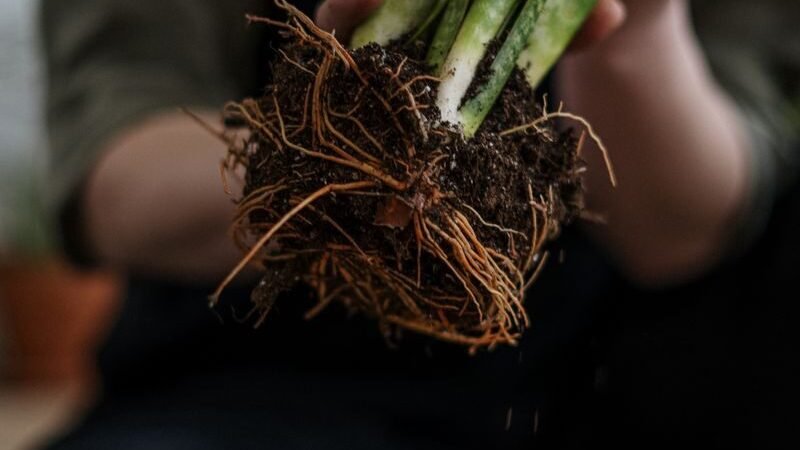
When several signs point to root-bound but you are not sure, slide the plant out of its pot and look. A severely root-bound plant lifts out as one rigid mass, holding the shape of the pot, with roots pressed in a dense layer around the outside. That is your answer.
How to confirm: gently squeeze the sides of a plastic nursery pot or tap the rim on a table edge, then ease the plant out with one hand supporting the soil. If loose mix crumbles and falls away from healthy-looking roots, the plant is fine where it is — put it back.
9. White, crusty salt buildup on the soil or pot rim
Fertilizer salts accumulate in old potting mix over time, leaving a white crust on the soil surface and around the rim. It damages root tips and locks out nutrients, which is why a plant with heavy salt buildup can look hungry no matter how much you feed it.
How to confirm: scrape the crust — it will feel chalky and dissolve in water. Salt buildup alone only earns a flush or a top-dressing if the roots have room. Paired with two or more other signs, it is one more vote for a full repot with fresh mix.
10. The soil smells sour or has shrunk away from the pot edge
Old mix breaks down: organic matter decomposes, air pockets collapse, and the soil pulls back from the pot edge in a hard, dry ring. Worse, compacted mix goes anaerobic and smells sour or fermented instead of earthy. This is degraded soil, and the roots inside it are struggling for air.
How to confirm: sniff the soil — healthy mix smells like a forest floor; bad mix smells like sour milk. If the smell is sour and the roots feel mushy, stop here: that is root rot, not a routine repot. Clean up the roots first with these rescue steps before moving to fresh soil.
Repot, top-dress, or wait? A quick decision table
| What you see | Your best move |
|---|---|
| Roots packed and circling, soil dries in a day, water channels straight through | Full repot — go up 1–2 inches in pot diameter |
| Salt crust and tired mix, but the root ball still has room | Top-dress: replace the top 1–2 inches of mix, no full repot |
| Stressed from pests, low light, or winter slowdown — but not root-bound | Wait; fix the primary stress first |
| Sour-smelling soil, mushy roots, or chronic sogginess | Emergency repot with root cleanup — this is rot territory |
When repotting is the wrong call
Repotting is stressful — roots get disturbed, fine root hairs tear, and the plant spends weeks recovering. Do not add that on top of these situations:
- Mid-winter slowdown. Growth has stopped and light is weak; fresh wounds heal slowly and new mix stays wet too long. Unless it is a rot emergency, wait until spring.
- You just brought the plant home. Acclimation stress plus immediate root disturbance is usually worse than leaving it alone for a few weeks — unless the nursery mix is clearly failing.
- The plant is flowering heavily. Repotting can cause bud drop. Enjoy the show first.
- The real problem is elsewhere. Pests, low light, or a watering problem will follow the plant into its new pot. A repot fixes roots and soil, not spider mites.
Also worth knowing: some plants genuinely prefer a snug pot. Snake plants, peace lilies, and many succulents are perfectly happy slightly root-bound — and a few, like peace lilies and orchids, bloom better for it. No roots out the drainage holes and no other signs? Leave them.
What to do next
Once you have confirmed two or three signs, the fix is straightforward. Slide the plant out, loosen circling roots, and move it into a pot just 1–2 inches wider in diameter — never a giant leap, or the extra wet soil invites rot. The step-by-step workflow in our monstera repotting guide works for practically any houseplant, and the DIY soil mix recipe gives roots the airy mix they have been missing.
Spring is the best window because new roots grow into the fresh mix as new foliage appears, but a genuinely root-bound plant does not wait for the calendar — repot when the signs say so, whatever the month.
Related rescues
- How to Repot a Monstera in 9 Steps (With Moss Pole Tips)
- Best Soil Mix for Monstera: A Simple DIY Recipe
- Root Rot: Signs, Causes & Treatment
How do I know if my plant needs repotting or just water?
Check for repotting signs before you water more. If the soil dries out within a day or two, water runs straight through, and roots are visible at the drainage holes, the problem is a root-bound pot, not a watering schedule — extra water will not fix it. If the soil is simply dry because you forgot to water, watering will fix it immediately. When in doubt, slide the plant out and look at the roots.
Can I repot my plant in winter?
You can, but only if the plant is genuinely root-bound or it is a rot emergency. Winter light is weak and growth is slow, so recovery takes longer and wet new mix is riskier. If it can wait until spring, let it wait. If roots are strangling the pot or the soil smells sour, do not wait.
What size pot should I use when repotting?
Go up just 1–2 inches in diameter from the current pot. An oversized pot holds a big reservoir of wet mix around a small root ball, which is one of the fastest routes to root rot. After a rot rescue where you trimmed damaged roots, you may even need to go smaller, not larger.
Do some plants like being root-bound?
Yes. Snake plants, peace lilies, spider plants, succulents, and many orchids are perfectly happy in a snug pot — some bloom better when slightly root-bound. For these plants, no roots out the drainage holes means leave them alone, even if you repotted their neighbors.
Should I loosen the roots before repotting?
Yes — gently tease circling roots outward so they grow into the new mix instead of continuing to coil around the root ball. If the roots are wound very tightly, score the bottom quarter lightly with a clean knife. Tease lightly rather than aggressively for orchids and finicky ferns.